
Policy Briefs
Addressing Europes Freshwater Ecological Debt
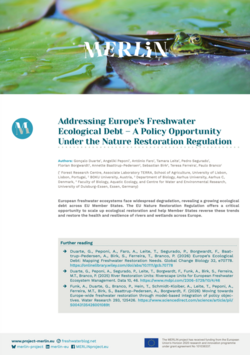
Freshwater ecosystems across Europe are under severe pressure from habitat degradation, pollution, and river fragmentation. A recent EU-wide spatial analysis covering European Union Member States and the United Kingdom reveals that restoration needs are widespread across European river networks. Despite decades of environmental policy under the Habitats Directive and the Water Framework Directive, large portions of freshwater habitats and river systems remain in unfavourable ecological condition.
However, the implementation of the Nature Restoration Regulation (NRR) creates a timely opportunity to scale up restoration efforts and address these challenges. By supporting coordinated, landscape-scale restoration planning, this new regulation can help Member States close policy implementation gaps, restore ecosystem functioning, and improve biodiversity outcomes across European freshwater environments.
Strengthening Freshwater Biodiversity Protection and Restoration under Natura 2000
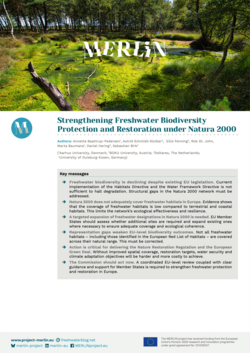
Freshwater ecosystems in the EU are under severe pressure from habitat alteration, pollution, water abstraction and climate change, and biodiversity continues to decline despite existing legal protections. This trend undermines the objectives of the EU Biodiversity Strategy, the European Green Deal and key environmental directives. Although Natura 2000 is the EU’s primary conservation tool, it remains insufficiently effective for freshwater habitats. Evidence from the MERLIN project shows that these habitats are inadequately covered, unevenly distributed and often fragmented within the network. A coordinated EU-level effort is therefore needed to review and strengthen freshwater designations under Natura 2000.
Mainstreaming freshwater restoration requires supporting multiple economic sectors to collaborate
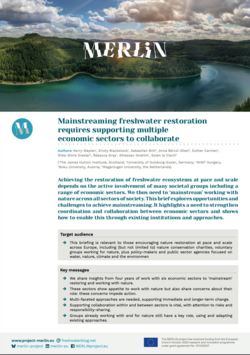
Achieving the restoration of freshwater ecosystems at pace and scale depends on the active involvement of many societal groups including a range of economic sectors. We thus need to ‘mainstream’ working with nature across all sectors of society. This brief explores opportunities and challenges to achieve mainstreaming. It highlights a need to strengthen coordination and collaboration between economic sectors and shows how to enable this through existing institutions and approaches.
Advancing the Water Resilience Strategy through Sponge Landscapes and Nature-Based Solutions for a Climate Resilient Europe

This policy brief outlines concrete policy recommendations for operationalizing the EWRS by addressing key gaps in the interplay between EU-level policy-making, Member State (MS) policy implementation and local action based on lessons learned from EU research projects. It brings together our current understanding of how sponge landscapes can contribute to hydrological functioning and climate resilience, and outlines pathways for EU-level, MS-level, and local actors to deliver sponge strategies at scale and to restore the water cycle and strengthen climate resilience. It draws on evidence and practical experience from EU-funded projects and demonstrates how governance, policy integration, innovative research, stakeholder engagement and finance can enable large-scale implementation, putting the EWRS into practice
Mobilising Diverse Funding for Nature Restoration in Europe
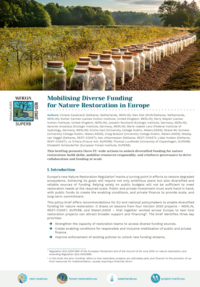
This briefing presents three EU-wide actions to unlock diversified funding for nature restoration: build skills, mobilise resources responsibly, and reinforce governance to drive collaboration and funding at scale.
A Structured Pathway for Upscaling Freshwater Ecosystem Restoration

From isolated efforts to coordinated, large-scale action
Healthy freshwater and wetland ecosystems are vital for people and nature, yet many need restoration. Progress in current restoration efforts remains too slow, small-scale, and fragmented. This brief calls for bold, coordinated action that aligns with EU policy goals and delivers lasting benefits for nature, climate, and society. The time to upscale is now.
Synergies and Tensions between the EU Nature Restoration Regulation and the Water Framework Directive
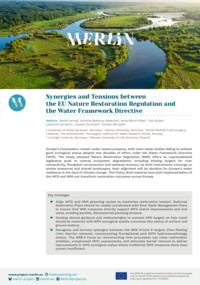
Europe’s freshwaters remain under severe pressure, with most water bodies failing to achieve good ecological status despite two decades of effort under the Water Framework Directive (WFD). The newly adopted Nature Restoration Regulation (NRR) offers an unprecedented legislative push to reverse ecosystem degradation, including binding targets for river connectivity, floodplain reconnection and wetland recovery. As both instruments converge on similar pressures and shared landscapes, their alignment will be decisive for Europe’s water resilience in the face of climate change. This Policy Brief explores how joint implementation of the WFD and NRR can transform restoration outcomes across Europe.
Common Agricultural Policy (CAP) - Design and Reform

The Common Agricultural Policy (CAP) plays a pivotal role not only in shaping Europe’s agricultural landscape but also in safeguarding broader environmental quality and societal well-being. At the same time, food production and rural economies depend fundamentally on healthy water systems.
This Policy Working Paper illustrates how water restoration can be embedded in future agricultural policies to enhance water resilience. It draws on research funded by MERLIN and Scottish Government Strategic Research Programme (KJHI-3-1 Land Use Transformations).
Ecosystem restoration and nature-based solutions: how do they differ and why does it matter?
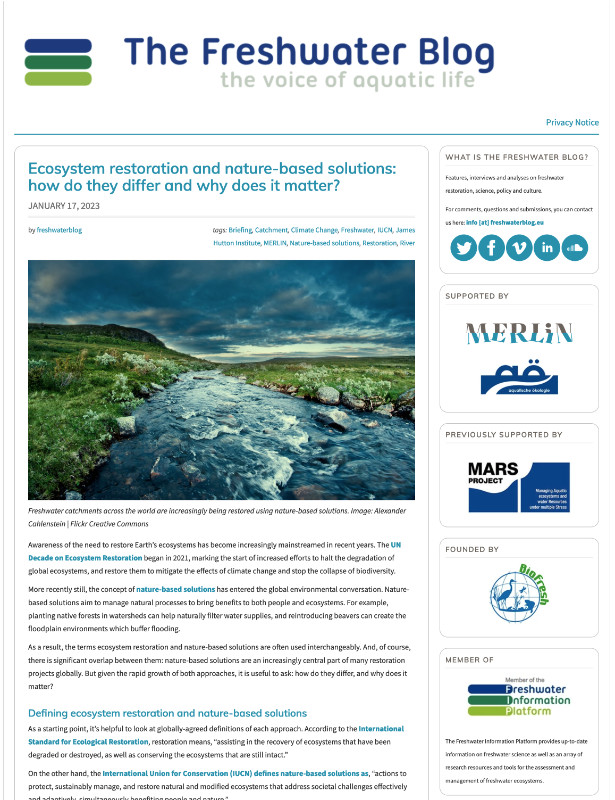
Awareness of the need to restore Earth’s ecosystems has become increasingly mainstreamed in recent years. The UN Decade on Ecosystem Restoration began in 2021, marking the start of increased efforts to halt the degradation of global ecosystems, and restore them to mitigate the effects of climate change and stop the collapse of biodiversity.
More recently still, the concept of nature-based solutions has entered the global environmental conversation. Nature-based solutions aim to manage natural processes to bring benefits to both people and ecosystems. For example, planting native forests in watersheds can help naturally filter water supplies, and reintroducing beavers can create the floodplain environments which buffer flooding.
Stakeholder engagement for the development and implementation of National Restoration Plans

The European Union (EU) Nature Restoration Regulation (NRR) mandates each Member State (MS) to develop a draft National Restoration Plan (NRP) by September 2026, outlining how it will meet restoration targets. A critical component of this process is broad-based stakeholder engagement throughout all preparation phases.
Research conducted by four large Horizon 2020 Green Deal restoration projects across various European ecosystems offers guidance on how to activate stakeholder engagement for the successful delivery of NRR targets and provides concrete examples and tools to support this process (see links at the end of the document for resources covering.
Comments on the draft Nature Restoration Law

compiled by the EU-funded projects MERLIN, REST-COAST, SUPERB, WaterLANDS and PONDERFUL
Five large EU-funded research projects, all operating at the science-policy interface, jointly analysed the text of the draft Nature Restoration Law. The involved projects include the four projects funded under the Green Deal (Horizon2020) Area 7 topic “Restoring biodiversity and ecosystem services”, and represent 168 institutions working at the interface of environmental science, application and policy.
The recommendations listed below result from a science-policy workshop hold in Brussels on 25th November 2022 that was organised by the Research Executive Agency of the European Commission and DG R&I, and attended by the project coordinators and by representatives of EEA, JRC, DG-ENV, DG-AGRI, DG-MARE, DG-REGIO and DG-CLIMA.